China Miéville has, so far, published four pages of a comic he’s written on his blog. (via)
Showing posts with label comics. Show all posts
Showing posts with label comics. Show all posts
24 January 2011
06 January 2011
Batmobile History
The Evolution of the Batmobile. I’ll always have a soft spot for the 60s TV show convertible. (via)
04 January 2011
Flex Mentallo to be Republished in Fall 2011
DC has just announced that Grant Morrison and Frank Quitely’s Flex Mentallo will finally be collected and published as a deluxe hardcover in the fall:
If youre a fan of Grant Morrison (and who isnt?), youll be stoked to know that FLEX MENTALLO will be published in book form this year. This marks the first time the four-issue mini-series written by Morrison and illustrated by artist Frank Quitely is being collected. FLEX MENTALLO sprang out of Grants mind bending and infamous run on DOOM PATROL.
Pick up this beautiful Deluxe Edition hardcover with bonus material this Fall.
The story was one of the first collaborations between Morrison and Quitely but has never been republished due to a lawsuit by Charles Atlas Ltd. Flex Mentallo’s origin story is a parody of Atlas’s famous “The Insult That Made a Man Out of Mac” ad that ran in comics in the 60s and 70s, and the character bears an undeniable resemblance to Atlas (c.f. the photo of Atlas in this article and the pinup of Flex Mentallo in this one). The case was dismissed but DC decided not to reprint the series, until today. (More info on the case, including Jim Shooter’s afadavit, here, and on its decision not to reprint it here.)
Flex Mentallo is important not just because it’s an early collaboration between Morrison and Quitely, who’d go on to reinvent the X-Men, Superman, and Batman, but because it is an amazing commentary on comics themselves and states many of the themes of fiction vs. reality that Morrison has continued to play with subsequently. It takes a tour of comics from their fun origins through the zany silver age to the dark 80s and toward Morrison’s idea of the future of comics, which he’s attempted to realize in his Batman work and others. Many have called it one of the greatest short comics series ever published, up there with Watchmen. Greg Burgas takes a stab at explaining why here.

The real question, since I own the original copies (and even had them bound into a hardcover), is whether I’ll need to buy the series again in this deluxe format with bonus material. (Answer: yes.)
03 January 2011
Law and the Multiverse
Law and the Multiverse examines how superhero (and villain) activities and powers would work legally. It looks at issues like anti-mutant discrimination, whether Iron Man would run afoul of the FAA when he flies in his suit (vs. a hero who can fly without one), the legal ethics of sentencing an immortal villain to life without parole, and so on. I recommend checking it out.
I think it falls a bit short, though, in its strict focus on applying the laws of our world to fictitious ones. Marvel’s Civil War, for example, is predicated on the idea that Marvel’s US legal system has adapted its laws to account for superpowered individuals. It’s likely that laws have been adjusted to allow for, say, evidence obtained by Batman to be presented in court. Otherwise either every criminal could demand to be set free because the chain was tainted, or conversely dirty cops could constantly lose evidence (or plant it) and claim a vigilante had messed with the scene. (via)
20 December 2010
Predictions for 2020: Comics
In the next decade, younger comics writers and artists will come of age and break into the mainstream publishers. They’ll have grown up reading 90s stories and the Gambit, X-Force, Venom/Carnage era of Marvel will see a resurgence.
Digital will continue to get more popular, but maybe not from DC and Marvel. As big companies they’re naturally more skittish, while Dark Horse and smaller companies will be more creative. The iPad’s screen size and dimensions lends itself more easily to manga-sized comics, so expect to see that slightly smaller form factor catch on with direct-to-digital offerings. In general I don’t see print dying out until digital offers an equally-compelling product, which won’t happen as long as they’re merely shrinking existing art down by 25%.
09 November 2010
Serenity: The Shepherd's Tale
This is it. I can feel it. It’s okay. We each get to be in the world a time, and I’ve had mine. It can be tough. It can be ugly. But I’m grateful for the journey and what I’ve stumbled across along the way.
 As it was cancelled long before its time, there are many stories that Joss Whedon never got to tell in Firefly. The film cleans up the main River Tam plot, but the character of Shepherd Book never got a chance to have his story told. In this new hardcover from Dark Horse Books, Zack Whedon tells Book’s tale from outlines by brother Joss, with art by Chris Samnee.
The story starts with what could be a deleted scene from Serenity and then flashes back to glimpses of Book’s life. We see some of his time at the abbey and some of his much-speculated career as a soldier. There’s a nice twist at just the right place, precisely as I was worrying, “this is it? The big secret is that he used to be a soldier?”
The graphic novel’s plot structure reminds me of Stephen King’s The Gunslinger. Both books start at the end and work their way back in time through embedded flashbacks. It’s a neat format that works nicely here and makes great use of the sort of overlapping narration Scott McCloud talks about in Understanding Comics, where the dialogue from the previous scene carries over to a panel in a different time/place, creating a contrast between the two settings. I don’t know that Whedon was thinking of The Gunslinger when he structured the story this way (he probably would have mentioned it in the backmatter along with the other influences he references), but I’ve always felt the same gritty, western feel in both the Dark Tower and Serenity ’verses.
While I enjoyed the book, reading it made me sad that the series ended so early. That Joss Whedon decided to disclose Shepherd Book’s backstory serves as further proof that no new movies are coming. I recommend The Shepherd’s Tale to anyone who loved Firefly and is curious about Book’s history, or just wants to revisit the trappings of the series for a few minutes. Amazon has it on sale for $9 and I would expect to see Dark Horse put out an iPad version as well.
08 November 2010
Suggested Real Name: Katherine "Kitty" Pryde
 Letters of Note publishes the pitch page for Kitty Pryde from 1978.

07 November 2010
The Walking Dead Google Map
I read The Walking Dead in hardcover, so I’m always about a year behind. Thus, this map has spoilers in it, but if you just look at it zoomed out you get a general idea of the landscape. It starts in Kentucky and moves to Atlanta.
04 November 2010
The Single Weirdest Thing in the Batcave
I’m pretty sure that this is the single weirdest thing in the Batcave. And considering it’s only two doors down from a robotic tyrannosaurus, that’s saying something.
Batman & Robin 16
It is worth noting that the way this finale plays out only underscores how unnecessary and fabricated the recent Bruce Wayne: The Road Home issues truly were, as if that wasn’t already readily apparent from those forgettable one-shots. It doesn’t take a close reading of this issue to realize none of the events of The Road Home fit logically within the confines of Morrison’s story.

25 October 2010
Gamble a Stamp 03
[The Dark Knight Returns] is the blaze of glory. It’s a revitalization before death. Watchmen is the autopsy. At the end, there are no secrets. What’s Flex Mentallo? It’s a wake, that time when everyone gets together, gets drunk, and talks about the deceased.
15 October 2010
The Road Home
I’m not reading any of DC’s “Bruce Wayne: The Road Home” books. Here’s Brian Hibbs writing about how poorly-produced the specials were:
[I]nstead of being “one shots,” as their solicitation text describes, the final product turns out to effectively be an eight-issue miniseries, with each one-shot being released with “to be continued in…” the next “one shot.” Naturally, someone messes up the production and at least one of the books “points” to the wrong “next” title. And let’s not forget to mention that the eight covers link up to form a single image – but that that image is neither the order of release, nor of reading order.
01 October 2010
Action Comics 893
Lex Luthor!!! Kneel before Grodd! You have walked into my ambush! And I have brought my biggest combat spoon—to eat your tasty brains!!!
—Action Comics 893, by Paul Cornell and Sean Chen
11 August 2010
All Six Volumes of Scott Pilgrim Hit the iPad, iPhone
Robot6 reports on the new standalone app.
The smaller manga size works perfectly on the iPad. I only got into Scott Pilgrim recently, in time for the last volume to come out, and it’s very fun.
14 July 2010
A Brief History of The Knight and Squire
That sounds awesome, and not just because Cornell’s idea of a “realistic take on British super-heroics” involves Dracula shooting vampires at England from his castle on the moon before getting into his magic space pirate ship.
30 June 2010
Temporary Costumes


Sometimes I think they redesign iconic characters just so, years later, you’re rereading a book and think, “oh yeah, they did that dumb thing for a while”. Morrison had to deal with electric blue Superman in the first bit of his JLA. Civil War has the Iron Spidey suit in it. Now Wonder Woman.
24 June 2010
Gay Comics: Young Avengers and Batwoman
 With a new volume of Young Avengers around the corner, I wanted to go back and look at that series again. What I’ve always loved about that book was how writer Allan Heinberg managed to make all of its characters seem like real people. In 2006 GLAAD honored the series for its depiction of the relationship between male characters Wiccan and Hulkling. Similarly, GLAAD awarded Greg Rucka and J.H. Williams III for their work on Batwoman in Detective Comics last year. I lent my copies of both series to Red Fuzzy Jesus’s Gabriel Hudson and this week we chatted about homosexuality in comics.
 Before we get into the characters’ sexuality, how did you feel about the stories overall?
I like both story lines a lot. I do not have nearly as much experience reading comics as you so I was a little surprised by some of the storytelling. Mainly I was impressed by how well emotion and character development can be conveyed through very concise dialogue. I think in both instances there’s a lot of assumed back-story or familiarity with the characters that I lacked. But, without exposition, I was able to pick up and follow along pretty quickly.
Young Avengers I think is a bit less standalone than Batwoman, who is an almost brand new character at this point. She was created in 2006 in a comic called 52 and had almost no appearances between then and this run of Detective Comics. As Batwoman she’s kidnapped by a cult and stabbed, which is referenced in Detective Comics. Her appearances as Kate Kane in 52 were as the rich ex-girlfriend of Renee Montoya. The first scene was a fancy dress party so the initial impression she gave was as a lipstick lesbian. Still, her debut got a small bit of mainstream press attention (with headlines like “Holy Lesbian, Batman!”) and the rumor was always that DC Comics got cold feet about how to use a gay character and shelved her for three years.
Both stories allude to gay criticism by the public and press. There’s a brief discussion of changing Asgardian’s name to Wiccan to avoid providing the press with an automatic joke. [“Ass-Guardian”] There’s also disapproval of Kate at a ball when she wears a tuxedo. Her line about taking criticism in stride refers to her character and the inevitable criticism of having gay characters.

However, that criticism was slight at best. Focus on the Family and Laurie Higgins of the Illinois Family Institute made harsh criticisms about the “homosexual agenda” finding a new pop culture vessel. But otherwise there was not much hysteria. This is another sign that gay people have moved toward greater acceptance. A gay character provokes more of a yawn than an outcry. Still, the direct address of criticism acknowledges its potential. The authors seems to be recognizing that there are people out there that may have a problem but their scorn is not factoring heavily into their decision making.
Writer Greg Rucka made a point of underplaying her sexuality in interviews. One quote:
Yes, she’s a lesbian. She’s also a redhead. It is an element of her character. It is not her character.
Reading the first few issues of the story, I had the feeling, though, that he was almost over-underplaying her sexuality, like he had something to prove. He makes it a point to show guitars and music posters in her house, to display her menorah. Like he’s saying, “there’s more to this character, I swear!”
It could be that he was just delaying her sexuality… because it’s featured more prominently later on. I think the comparison to straight characters is fair here. Some comic book characters are immediately introduced as ladies’ men (Tony Stark) or awkward around girls (Peter Parker) but for most their romantic side stories develop later. It could just be that he was establishing other things about her character first the way other superheroes are established before their attractions are introduced. That doesn’t necessarily indicate cold feet about including a lesbian storyline, just a hesitance to kick it off by announcing her lesbianism, which is a good use of restraint.
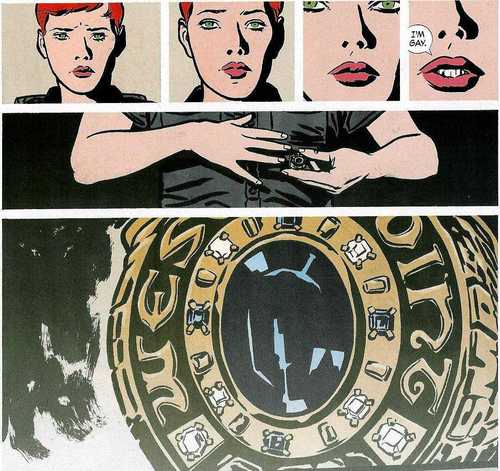
As the second story arc comes along, Rucka brings her sexuality to the front, in the present with her dancing with Captain Sawyer and in the past with “Don’t Ask, Don’t Tell”. How did you feel about the flashback sequences with her at West Point?
I think it’s interesting how hard she tries to be a “legitimate” hero. By that, I mean, she doesn’t start out trying to help people with vigilante activities. She wants a career in the military. But, she is faced with the impossible choice of denying who she is and hurting others. This eventually leads her to vigilante justice because she cannot deny who she is for a career.
I think this part of the story rings particularly true. For the most part, arguments against DADT have been phrased as counterarguments toward attacks on gays that have limited direct applicability to the military. But there have been fewer affirmative arguments in favor of repeal. Lately, military leaders testifying before Congress and in other venues have argued in favor of honor and integrity; two qualities long associated with military service. It is unfair to ask military members to sneak around, to call their partners “roommates”, and live double lives. The choice between a life of service and a life of honor is an unfair choice to be imposed.
Similarly, outside the military, many LGBT people find themselves in the gay catch-22. One is simultaneously condemned for not participating in institutions from which there is exclusion. Often, anti-gay groups deride the gay community universally as promiscuous and insincere about relationships. They then turn around and use the purported promiscuity to support bans on same-sex marriage. It is contradictory to criticize people for not mirroring relationships they are told they cannot have.
Today’s younger gays see long-term, committed relationships as an option for them in adulthood previous generations did not perceive. So they are “free” to pursue the typical heterosexual norm. As a result, the stereotype of the back alley gay man is fading away. In the same way, had Kate seen a military career as an option she might have gone on to achieve a high rank and legitimate heroism. Likewise, it is unfair for the military, police, or Kate’s military father to criticize her vigilantism because she’s told legitimate service is not an option. Fortunately, her father eventually came around to support what she was trying to do.
Yet Kate, in putting on a mask every night, is quite literally hiding part of who she is from the world.
With good reason. If she didn’t wear a disguise she could easily be harmed in her regular life. Or worse, those close to her that lack super powers could be harmed as a way of getting back at her. So, there’s a practical concern behind wearing a mask.
Gay people still face something similar. As much progress as we’ve made, there are still many situations in which it is not safe to come out. And safe is not put in quotations there because it really is a question of harm. Gay people used to be asked whether they were out or not. Now, more commonly, they are asked how out they are. Meaning, there are varying degrees of disclosure. A person might be out among close friends but not out at work. A person might be out to some relatives but not others.
And there is real harm at stake. Losing a job or being denied a promotion is harm. And as tolerant as many people profess to be, there’s a more subtle exclusion from the old boys network or male bonding rituals in professional life that need to be considered. A lot of what contributes to career progress is collegial relationship building with superiors. Coming out can inhibit that. Also, gay people have to be concerned if their kids will be made fun of at school or if their parents will be embarrassed in their community. This is similar to the concern superheroes have for the well being of those around them.
Much has been made about the volume of gay men in white collar executive or artistic positions. Some have suggested that whatever predisposes one to be gay also endows them with the qualities necessary for professional work, or deprives them of whatever is necessary for manual labor. Others hypothesize that, because gay men do not have families to support, they are freer to focus on careers and climb the corporate ladder more quickly. I think a more reasonable conclusion might be that there are more gay men in white collar and arts-based professions because it is safer to be out in those lines of work. It is easier for a gay man to be out as an attorney than a construction worker.
Acceptance of gay people, while not universal, is a lot more common now than just a few years ago. For that reason, shame or social rejection is not enough to keep most in the closet. If one is rejected by friends and family there is enough of a supportive environment out there to minimize the hurt of rejection. What keeps many GLBT in the closet now, even partially, is real, measurable, demonstrable harm. It’s the same thing that keeps the mask on Batwoman. She’s out to some. Her dad knows her full identity. But, there’s still too much risk to be completely unmasked. As much progress as we’ve made, there is still a risk to being out that has to be calculated. And, for each gay person that calculation is varied and personal. That’s why I don’t like forced outings by the politically opportunistic. You never know what harm you may be causing to someone by revealing things about there identity. This is true even if you believe the world would be a better place if all gay people were out.
Turning to Young Avengers, we see the younger generation in Billy and Teddy’s relationship. Kate faced real adversity because of her sexuality, giving up a promising career as an Army cadet. Billy and Teddy come out to their friends and parents are immediately accepted. Do you think it’s more common now for teenagers to be able to admit their sexual orientation, or even be able to have it figured out by high school?
Oh absolutely! It’s a fairly new phenomenon but for many gay people adolescence now occurs during adolescence. For so long people typically didn’t realize they were gay, or couldn’t tell anyone until their late 20s. Now it is more and more common for young people to come out and for their friends and family to be supportive. When I read the scene in which Billy and Teddy discuss whether they should tell their parents about their super-heroism, and are subsequently affirmed in their relationship, it was moving.
 I’ve had several conversations with gay friends in which there are two coming out stories, the real event and the fantasy. Often, the latter is more detailed. People really do dream about their family meeting their partners or their parents not just being tersely accepting but celebrating in their gay child finding love. I can’t help thinking that the author of this storyline has a lot of familiarity with the gay experience.
The best news is, the story had resonance because it’s actually happening. Parents often know their kids are gay before their kids tell them. And when they do, it’s a chance to build the relationship, not destroy it.
Sometimes GLAAD will give recognition for just showing up. Inclusion of a gay character is enough. But I think we’re to the point where there needs to be more. Giving characters dimensionality or mirroring actual changes in the gay community is praiseworthy. There’s a new gay narrative being written and it’s refreshing to see that narrative appearing in a medium marketed almost exclusively to young men.
Right. Comics tend to be filled with women in tight-fitting costumes posed in impossible contortions. I don’t know how much you ever played XBOX live games, but you can’t go five minutes without someone calling you a “faggot” over voice chat. It’s not the most progressive community and comics are filled with ads for video games.
That’s what makes it even braver. Immediately adjacent to the coming out scene between Teddy and Billy there’s an ad for Bod Body Spray that shows a cartoon guy with women swooning around him. I’ve always thought that gay rights would reach an apex when professional male athletes felt comfortable being gay. This is close to that. A publication, with very masculine advertising, has young gay men being close and expressing their love for each other.
I wasn’t as surprised by Batwoman. She’s a lesbian but she’s also hot with a skin tight costume and giant breasts. Lesbianism can easily be folded into a male fantasy world. Your average sorority girl can become a lesbian after a few shots but it’s mostly for the entertainment and pleasure of men. For two male characters to be gay in a male dominated medium is quite progressive. Acceptance has been a double-edged sword for gay men. On one hand, people are more comfortable with a gay man being around. But on the other, they require him to be sassy, funny, or flamboyant. It is for this reason I never considered Will & Grace a big step forward. It was gay men on prime time network TV but it was the type of gay court jester that’s easier to swallow. A heroic, competent, complex gay man is still a rare thing to see.
I should also note the dimensionality of these characters. I would similarly not be surprised if two gay men in a comic book flitted around fulfilling every type of swishy, prissy stereotype. But these young men are masculine. They literally engage in acts of heroism. They’re tough and they know how to fight. They just happen to be gay. The dimensionality within their individual characters and their relationship belies the usual treatment of gay men when straight men are present.
Yeah, both Billy and Teddy are drawn in sports jerseys at different times. It’s not like Kurt on Glee who’s always wearing ascots and talking about his skincare routine (though I think that show has done a good job with his relationship with his father).
A few weeks ago I saw a sketch on The Soup in which a woman wants to find a “real man” i.e., not gay. I know it’s just a silly sketch but it caused me to think inside, “I am a real man!” Gay men sometimes have to remind people that they can be fully capable leaders and gay. These characters do that well. They are guys. They just happen to love other guys.
And fight crime! Despite their secret origins Batwoman, Wiccan, and Hulkling are all typical superheroes, complete with tragic origins. The Batman books practically require a hero to have dead parents, and Billy was bullied as a kid, making him want to protect others. And many in our society still think homosexuality is a result/response to abuse.
That is an unfortunate misconception that has stuck around. Many profess a supposed link between childhood trauma—sexual or not—and being gay or lesbian. Opponents of gay rights use this to undergird arguments claiming gayness is not an identity trait but a defect. Returning to the topic of DADT, that has been an argument out there that the presence of same-sex attraction is evidence of damage making one disqualified from military service. It is surprising today that that kind of thinking still gets any traction.
However, gay people can have a good deal of trauma. Whether it’s getting bullied in school, familial rejection, or just a generalized feeling of being different, there are some common developmental experiences. At the beginning of the Young Avengers series I assumed the shape shifter might be gay because he talked about being different and wanting to pass as one of the guys in the locker room.
Superheroes also have a common theme of trauma in youth. Bruce Wayne’s parents are gunned down in front of him. Peter Parker’s uncle is killed by the assailant he could have stopped. And these traumas are instrumental in their new identities as superheroes. But, these traumas did not make them superheroes. A bite from a radioactive spider or a toxic spill or something else gives the hero his or her powers. The trauma usually inspires what they do with those powers. Batman, Spider-Man, and others want to fight crime because they are familiar with the pain it causes.
In the same way, childhood trauma doesn’t make a person gay. But it can shape how one handles it. Many gay people empathize with other outsiders and outcasts because they know the pain of rejection. In Billy’s story, he accepts his bullying and learns to live in quiet avoidance until he sees someone else being bullied. His decision to use his powers to help others comes after he recognizes his pain in another. Many gay people live similar lives until they see someone else trapped in a closet. It was an open secret for years that Rosie O’Donnell was gay. But she didn’t officially come out publicly until she identified with a pair of adoptive parents in Florida forced to live in the closet or risk losing their children. The trauma is not what makes the superhero. Likewise, the trauma is not the cause of gayness but it can lengthen the road to personal acceptance and inspire many to activism.
23 June 2010
DC iPad App
Following up from last week, DC Comics has now released its own iPhone/iPad app, also powered by comiXology (iTunes Link). Newsarama has the full list of its launch titles.
Recommendations:
- All-Star Superman
- Green Lantern
- Batman starting with 655
- Action Comics starting with 844
- Tiny Titans, especially for kids
- Sandman
- Planetary
Subscribe to:
Posts (Atom)